Posts

Showing posts with the label Mental Relativity

The Dynamic Model (2) – Transmutation of Particles and Waves

In this second article in the Dynamic Model series, I’m going to explore really intriguing problem – how particles can be transmuted into waves and vice versa. Read the complete article here:  The Dynamic Model (2) – Transmutation of Particles and Waves

Part Two of the Mental Relativity Ph0ne Conversation

Click to listen or download: 6-13-91

Practical Mental Relativity - A Phone Conversation - Part One

mp3 of a phone conversation between me and Juniko Moody regarding how to apply Mental Relativity psychology theory in a practical way in every day life. Click to listen or download. 6-13-91

Origins of Mental Relativity

Many people have asked how we came up with the Mental Relativity Theory. Well, it didn't happen all at once. In fact, it all began with our attempt to understand the structure of fictional stories. That was a three year full-time effort, 8 hours a day. And the theory we now grew out of quite different concepts those we have now refined. In going through my archives, I just discovered four hours of recordings we made in 1991 to document our very first attempt at a "complete" theory - kind of a unified field theory of story. Here are all four hours of audio in mp3 formt, divided into 8 parts. Enjoy! Origins of the Dramatica Theory - Part 1 of 8 Origins of the Dramatica Theory - Part 2 of 8 Origins of the Dramatica Theory - Part 3 of 8 Origins of the Dramatica Theory - Part 4 of 8 Origins of the Dramatica Theory - Part 5 of 8 Origins of the Dramatica Theory - Part 6 of 8 Origins of the Dramatica Theory - Part 7 of 8 Origins of the Dramatica Theory - Part 8 of 8

Op Quads

Image
Dramatica software's model of Mental Relativity psychology, for which we received a patent for its implementation in the Story Engine, is based on a series of operations - dynamics that are applied to the dramatica structural model to twist and turn it like a Rubik's Cube of psychology. Like the structure, the operations fall into Quads (groups of four). The following picture shows some example Op Quads that are applied to the StoryEngine, and what they do (in short-hand symbols).

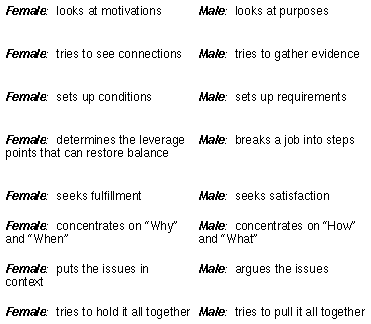
How Women & Men Approach Life.

Image
Here are some generalizations I worked up during our early development of the Mental Relativity Theory.

Transcription - November 29, 1994

It’s November 29, 1994 Just about noon. A little past noon. Thought for today: dealing with duration of an event, or duration of an activity as the principal female means of measurement. When you look at how long something takes to be accomplished - how long it lasts - everyone is aware of these. It seems to be intrinsic in the nature of women, which is why time locks don’t have much meaning to the female perspective in terms of emapthy. It’s not a certain fixed, objective sense of time, but how long it “seems” that’s important. When you deal with an option lock (because you are limited in your options) the longer the problem lasts - the more duration it has - the more it irritates, much as if you take your finger nail and start scratching away at your skin: the longer you do it, the more irritated it will become. Or, if you stay out in the sun and get a sunburn, the longer you are there the worse the burn will be. Eventually, it gets irritating to the point you can’t stand it a...

Theory Notes 6-25-94

Theory Notes From Melanie (Transcription from an audio recording) What follows are some notes, each of which would be a topic for an article to be written or a key point in a topic to be written. I’ll put the date with each topic, list it and speak a little bit about it First topic-June 25, 1994 Saturday I’m reading a book called The Visual Centers of the Brain where it talks about how there are of course, only three kinds of cones for color of vision and naturally 3 types of cones in terms of subjective view, tying in with 3’s. And it would be interesting to look at the concept that the reason that we see in 3 primary colors is not because that is really how they work, it is a continuous spectrum after all, but simply because that is our subjective view of what color is doing. Therefor color sense is a subjective interpretation, does not exist in any objective situation and that three cones would match the 3 points of the subjective view of the world and therefor be a dynamic impre...

Problems & Inequities

From 1993: Problems and Inequities There are two kinds of difficulties that enter our lives: Problems and Inequities. In fact, the are not unrelated but simply different ways of appreciating an imbalance. When viewed with Reason this imbalance appears as a problem. When viewed with Emotion the imbalance appears an as inequity. Reason functions to define items by separating them from the background against which they exist. Therefore, a problem is an identification of the specific area of imbalance, which allows one to focus corrective efforts at the source. Looking for a specific solution to a specific problem works fine unless the problem is just a symptom or manifestation of some greater imbalance that has not yet been plumbed. In this case, the problem might be impossible to solve because it is reconstructed by the greater imbalance the moment it is eliminated. On the other hand, the problem may disappear, only to cause another problem elsewhere as the greater imbalance redir...

Indicators of Justification

From November 2, 1993: Indicators of Justification Justification functions in a manner similar to sensory perception. When a sensory nerve is stimulated, the nerves around it become numbed so that the apparent stimulation is made more distinct. When a sensory nerve is numbed, the nerves around it become more sensitive to pick up the slack. Similarly, when a justification causes one to become sensitive to a stimulation, the surrounding thoughts and feelings become numbed in order to mask (and thereby protect) the sensitivity. If justification causes one to become numbed to a particular kind of stimulation, the thoughts and feelings around this area become overly sensitive, tending to cause reactions that redirect the stimulation from the numbed (blinded) area. Both of these techniques can aid in survival. If becoming sensitized to a particular stimulation (such as the howl of a dangerous predator) is useful, then numbing the area around that stimulation makes it stand out from the ...

Triangulating

From November 1, 1993 - an article documenting some of our early work on Mental Relativity. Reason measures problems, Emotion measure inequities. For every dissonance of which we become aware, we perceive it both as problems and as inequities because we measure it by both our Reason and Emotion. When deciding how to alleviate a dissonance, we often try to be efficient by addressing only one leg of the offending item by treating it solely as either a problem OR an inequity. Although this may alleviate most of the dissonance, it will never alleviate all. Still, alleviating all dissonance is not always the best course. Sometimes a problem may be easy to solve, correcting 90 % of the dissonance, but the 10 % causing inequity might require an enormous outlay of emotional energy, making it counter-productive. The cost of eliminating the inequity might very well exceed the benefits obtained. Cost VS Benefits is an important concept to consider, but for purposes of understanding triangulat...

Psychology of Mental Relativity

An article I wrote in 1991 to document an aspect of our early work on Mental Relativity theory: Psychology of Mental Relativity Can, Want, Need, and Should How do Thought, Knowledge, Ability, and Desire relate to the motivation to act? In our previous article, we discussed how Thought and Knowledge are used to determine Ability and Desire. Ability and Desire are passive words, they describe a condition with no reference to action. Action itself requires the passage of time. Words that describe the same qualities but infer action are Can and Want. Can infers Ability that has not yet been employed, or in other words: Knowledge that is not yet translated into action. Want infers Desire that is not fulfilled, or in other words: an unknown that is not yet understood. To fully appreciate these distinctions it is necessary to divorce ourselves from the internal sense that Want is "something I'd like to use or do" and that Can is "something I could have or accomplish...

Section Two: Thought and Knowledge

An article I wrote on February 21, 1991 regarding the state of a portion of our early work on Mental Relativity theory: Section Two: Thought and Knowledge When we reconfigure the equation to read, t=k(a*d), we see that Thought equals Knowledge times Desireability. Since Desireability is a quantity of data that is Unknown, Thought equals Knowledge times the Unknown. What this infers are that there are two TYPES of thought: One type in the deductive logic that rates Ability, the other type is the inductive logic that rates Desire. The type of Thought that generates Reason is Reasoning. The type of Thought that genrates Emotion is Feeling. Together, these two types of Thought constitute Thinking. Note that Thinking and Thought contain BOTH Reasoning/Reasons and Feelings/Emotion. This is somewhat divergent from the popular misconception that Thinking and Feeling are two opposite endeavors. In summary, Thought is the result of the movement of a pattern of data, either to compare it to ...

t/k=a*d Revisited

An article from February 22, 1991 The Mechanics of Mental Relativity Section One: Ability and Desire In our previous article, we explored t/k=a*d as describing Mind. Mind is made up of four elements, Thought, Knowledge, Ability, and Desire. These four elements relate in a relative way as indicated by the equation and described in the previous article. But how are the specific elements created? Where do they come from, and what are the mechanics of their development into items that have a measureable value? Assume, for the moment, that each mind contains two processing units, the Left Mind, and the Right Mind. These two units are similar in many ways to the popular conception of Left Brain and Right Brain, but differ significantly in several crucial respects. Further, the word "Brain" tends to conjure up a variety of connontations in addition to inferring a physiological relationship. It is not our intent to describe the physical layout or functioning of Mind, as Mind ca...

SIKE

Back in the very early 1990s I wrote this extended series of notes to document the concepts about psychology we were developing at the time. Ultimately, we moved beyond many of these, yet they provide a map of where our thinking was at the time and, hence, how we eventually managed to arrive at the final version of Mental Relativity. Inequity Internal Perspective External Perspective of same inequity Internal perspective will find inequity to be outside of self in observation. Inequity is always perceived in the side that divides and that the methodology of that side will be employed to determine thecourse of action or state of being required to bring inequity into balance. From external perspective -- the inequity can be from inside or outside. If inequity is truly outside (external perspective), that person has no unresolvable problems. EXTERNAL POV -- If the problem is really inside, the problems is going to be on the multiplying side. If it is on the multiplying side, it will be ...

k=tm2

Here's an archival article from they early days of our work on the math side of Mental Relativity psychology theory. We later moved on from the equation at the heart of this article to a more accurate and fruitful form. But, for you fans, here's the original article in all its misguided glory. See it as a step on the path to the refined understandings in which our work eventually culminated. k=tm2 A simple equation that describes relativity in the inner universe in the same way e=mc2 decribes relativity in the outer universe. k is Knowledge. t is Thought. m is the size of Mind. The exponent "2" is the function of time. Simply stated, the equation shows the relationship of the amount of knowledge to the magnitude of thought. Like e=mc2, k=tm2 equation describes these relationships from the perspective of an observer inside the universe. In the physical or outer universe, the speed of light appears to be a constant. If seen from outside the physical universe, i...

The Next Step

After our original equation for Mental Relativity, which was not unlike a mental equivalent of E=MC2, we realized that four variables were needed to fully describe the relationships we werre seeking to understand. Hence, I penned this next article on August 1st, 1993 to document where our work had taken us at that moment. Mental Relativity t/k=a*d A simple equation that describes the interrelationship between Thought, Knowledge, Ability, and Desire. Taken as a whole, the equation describes Mind, which is awareness. The Left Side of the Equation: Thought and Knowledge Assume a brain with no thought and no knowledge. An observation stimulates certain neurons. Each stimulated neuron is raised to the next level of energy, building up a charge and making it more unstable. But the neuron will not fire as it still has more potential to absorb. A second observation, identical to the first, stimulates the same neurons. They are all raised to the next level of energy, building up a greater...